
More than 1,000 years ago, Indigenous people gathered, built monumental earthworks and shaped a landscape that visitors can still explore today.
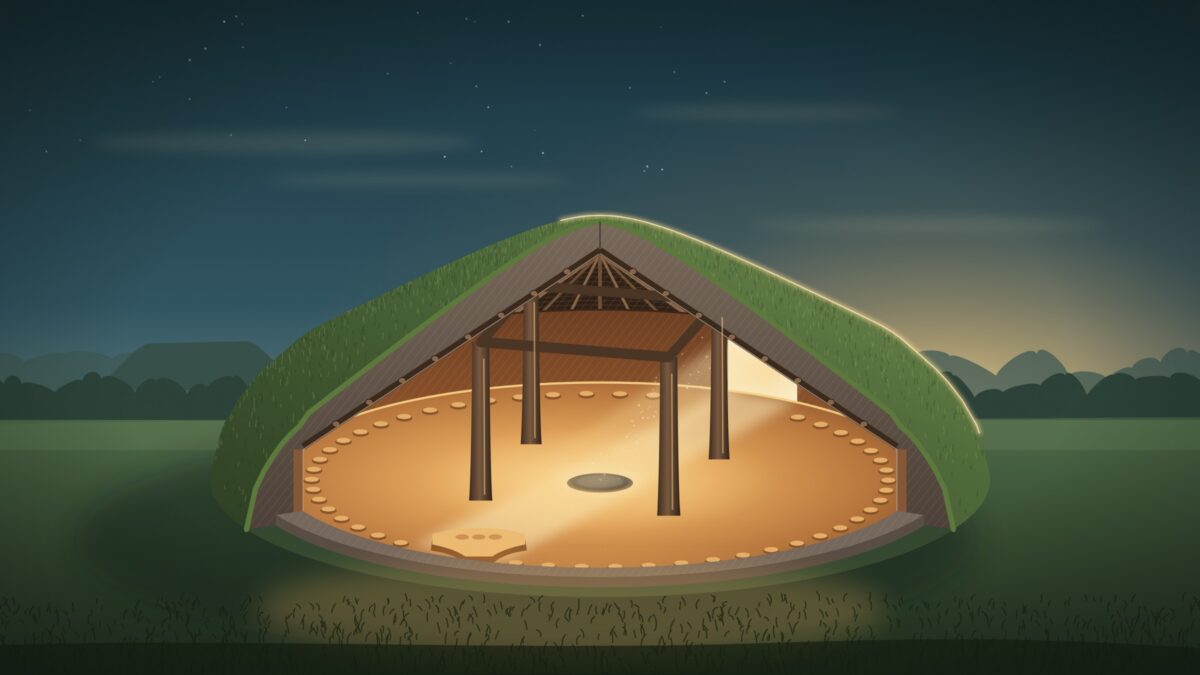
At Ocmulgee Mounds National Historical Park in Macon, Georgia, a reconstructed Earth Lodge preserves the original clay floor of a ceremonial council chamber dating to A.D. 1015. Nearby, the Great Temple Mound rises 55 feet above the surrounding landscape.
Those landmarks are part of a much longer story. People have lived in this area for more than 12,000 years, and the park also preserves an ancient ball field and the site of a British trading post established centuries after the Mississippian mounds were built.
Explore the illustrated interactive below to uncover the stories behind four historic locations. Select each discovery point to learn about the people and events that shaped this remarkable landscape.
What lies beneath?
Explore 12,000 years of history at Georgia’s Ocmulgee Mounds, one discovery at a time.
0 of 4 places explored
People have lived in this area for more than 12,000 years. The mounds are younger: Mississippian builders began them around A.D. 900. Select a place to explore it.
You’ve explored all four places. One more part of the story remains.
Explore the four places
The Great Temple MoundClimb a monument built centuries ago
The Great Temple Mound
Climb a monument built centuries ago
Around A.D. 900, Mississippian people began building earthen mounds for their leaders on the Macon Plateau along the Ocmulgee River. The Great Temple Mound is the largest of the seven that survive in the park, standing about 55 feet tall.
Visitors can climb to the summit on the designated route, where the National Park Service notes you can see downtown Macon to the southwest. The park asks everyone to stay off the mound slopes.
The Earth LodgeStep inside a 1,000-year-old gathering place
- Original clay floor, carbon-dated to A.D. 1015
- Walls, roof and earth covering reconstructed in the late 1930s
The Earth Lodge
Step inside a 1,000-year-old gathering place
Mississippian people met in this round council chamber. Its clay floor is original: built by Native people and carbon-dated to A.D. 1015.
The walls and roof are not. Civilian Conservation Corps and Works Progress Administration crews reconstructed them in the late 1930s, under the direction of archaeologist A.R. Kelly.
Formed into the floor are a circle of 50 seats, a large fire pit and a raised clay platform shaped like a bird. The building is 42 feet across, with four support logs set in a square holding up a cone-shaped roof.
The ancient ball fieldWhere people gathered to play
The ancient ball field
Where people gathered to play
On the walk toward the Great Temple Mound, a railroad bridge leads to a large field that the National Park Service identifies as an ancient ball field, where games such as stickball and chunkey were played.
Chunkey used a disk-shaped stone. One player rolled it across the ground while others threw spears after it, and the spear that landed closest to where the stone stopped won.
Mississippian people also played a ball game much like modern lacrosse, usually between two rival towns.
The trading postWhere different worlds met
The trading post
Where different worlds met
From 1690 to 1715, a British trading post operated here. Muscogee (Creek) people traded animal skins for European goods such as bells, glass beads and muskets.
According to the NPS, early Creek people are believed to have lived in the surrounding area until the Yamasee War of 1715.
Final chapterThe story never ended
The story never ended
Ocmulgee is the ancestral homeland of the Muscogee (Creek) Nation. Muscogee people lived on this land until a series of treaties, culminating in the 1826 Treaty of Washington, forced their removal.
Removal did not end the relationship. The Muscogee (Creek) Nation, now based in Oklahoma, continues to maintain cultural connections to this landscape. Each September, the park’s Ocmulgee Indigenous Celebration brings Indigenous dancers, artisans, storytellers and others here to share their heritage.
The mounds, the floor of the Earth Lodge and the fields around them are not relics of a vanished people. They belong to a living history that is still being told.
Sources: NPS: History and culture; NPS: Land donation news release; NPS: National Park Getaway
Revisit a place
Illustrations are artistic interpretations based on contemporary site references and National Park Service historical information. They are not archaeological maps or reconstructions of the site at a single moment.
Ocmulgee remains the ancestral homeland of the Muscogee (Creek) Nation, whose cultural connection to the land continues today. Its history is not simply a story of the distant past.
Want to explore the park in person? Read our complete guide to visiting Ocmulgee Mounds National Historical Park for trails, park hours and recommendations for where to stay and eat in nearby Macon.
Your home base for the great outdoors. Sign up for the Camp & Country newsletter
Keep the adventure going. Follow Camp & Country on Instagram, Facebook, X and Bluesky for outdoor inspiration, trip ideas and more.