
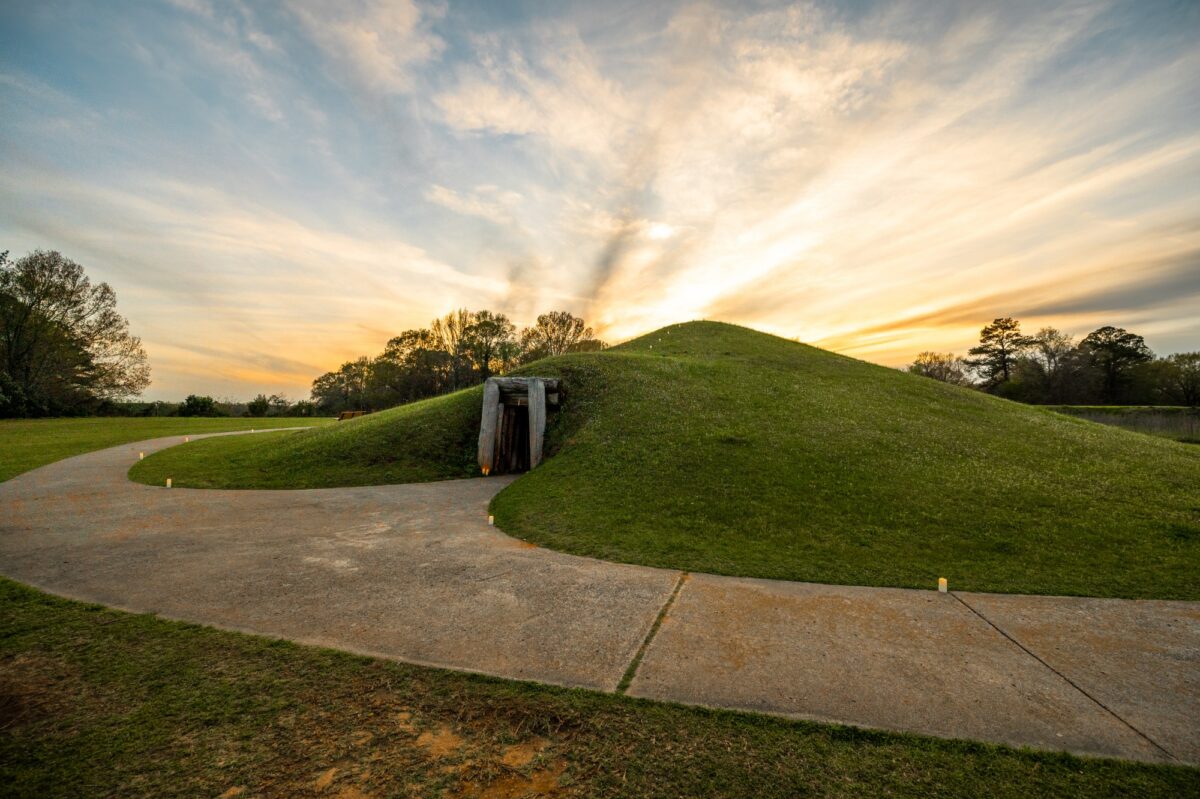
Just outside downtown Macon, Georgia, Ocmulgee Mounds National Historical Park preserves an Indigenous cultural landscape with more than 12,000 years of human history. Visitors can explore massive earthen mounds, archaeological sites and a reconstructed Earth Lodge with its original clay floor.
Here’s how to plan a visit.
Ocmulgee Mounds’ Indigenous history
Indigenous peoples lived here for thousands of years before European settlers arrived. The park interprets the Paleo-Indian, Archaic, Woodland and Mississippian periods, with the surviving mounds built during the Mississippian period.
Ocmulgee remains the ancestral homeland of the Muscogee (Creek) Nation, now based in Oklahoma following the forced removal of Muscogee people from the Southeast.
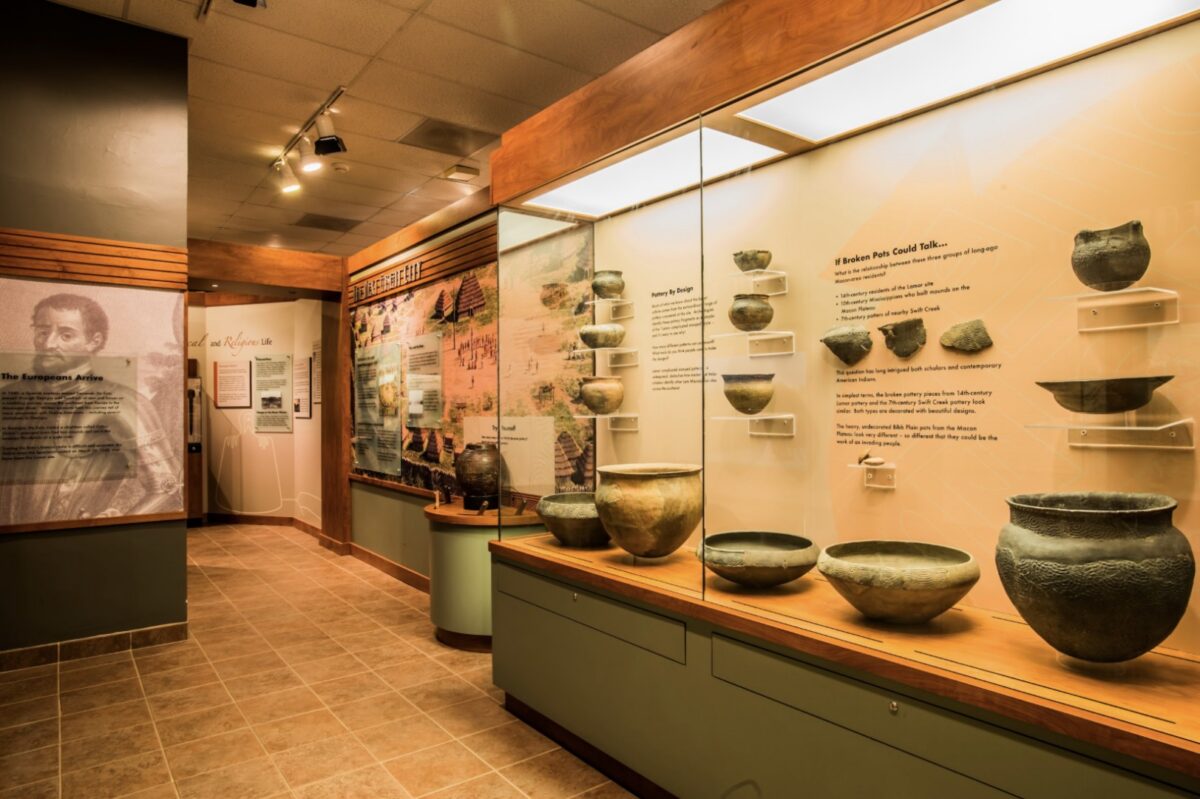
Inside the visitor center, exhibits and a 17-minute film explain the history of the people who lived here.
Exploring the park
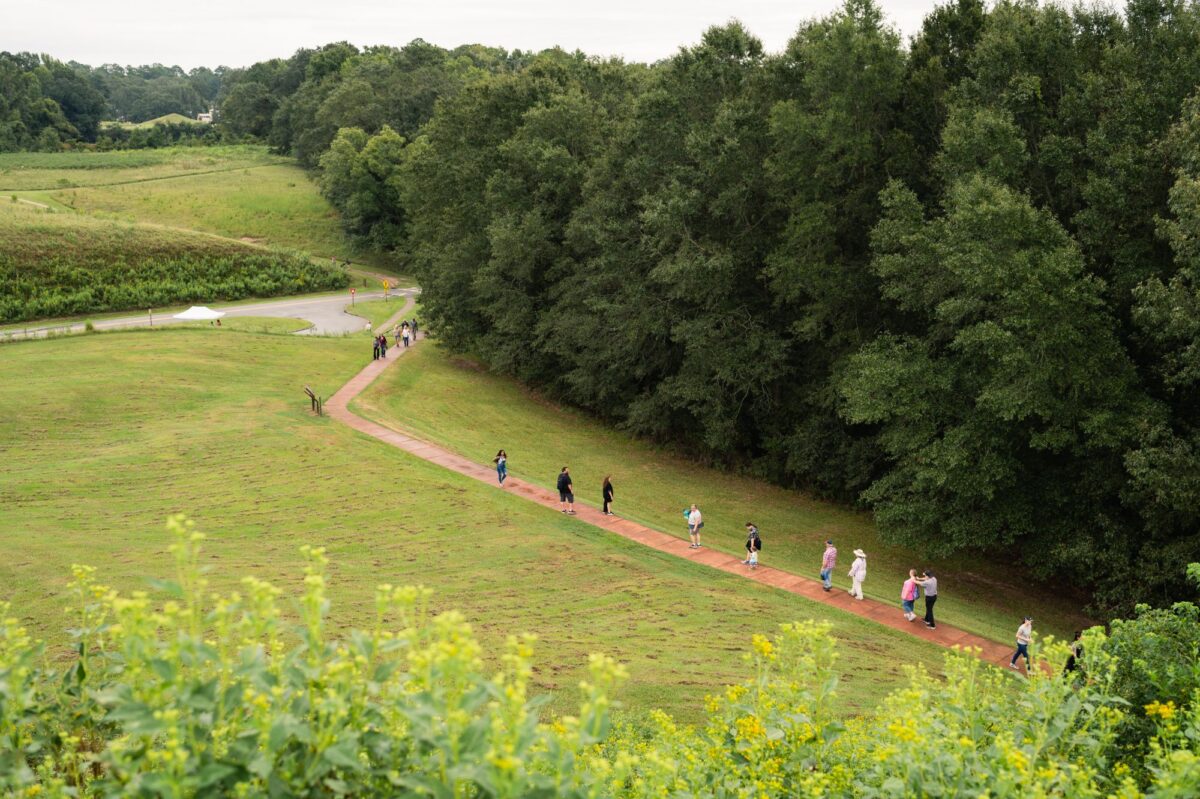
The park has eight miles of trails. The Great Temple Mound, a massive earthen structure built by Mississippian people, is the park’s biggest draw. If you’re short on time, this is the thing to do. From the visitor center, it’s a 1-mile round-trip walk over paved and unpaved surfaces, with stairs leading to the top.
On the way, stop at the Earth Lodge, where visitors can enter a reconstructed ceremonial council chamber and see the original clay floor, dated to A.D. 1015.
For a half-day visit, I recommend adding a walk through the park’s wetlands and forests. Fill your water bottle at the visitor center before heading out.
Before heading back to the visitor center, take the 1-mile Opelofa Trail loop from near the Great Temple Mound parking lot. For more walking, add the quarter-mile Opelofa Loop Trail, an offshoot through the woods. Explore other park trails as time allows, then head back to the gift shop.
What visitors need to know
The park is a short drive from downtown Macon. Macon is about a 90-minute drive from Hartsfield-Jackson Atlanta International Airport, depending on traffic.
Macon can be warm and muggy from spring into early fall, so start early to beat the heat.
Admission is free. The grounds and trails are open from 8 a.m. to 5 p.m.; the visitor center and Earth Lodge are open from 9 a.m. to 5 p.m. The park closes on Thanksgiving, Christmas and New Year’s Day. Check park hours before visiting.
Stay, eat and drink
Hotel Forty Five, part of Marriott’s Tribute Portfolio, is named for the 45-degree angle at the intersection of Cherry Street, First Street and Cotton Avenue. The 94-room hotel occupies a former insurance building, with fun design touches from its past alongside modern comforts. It’s in an excellent downtown location, with many restaurants and bars within walking distance.
You won’t lack choices in Macon, but don’t miss:
- Longleaf Distillery: This small-batch distillery and cocktail bar offers inventive cocktails, mixology classes and food. The company pledges to plant a longleaf pine for every bottle sold.
- H&H Soul Food: Come for hearty comfort food, including stacked biscuit breakfast sandwiches, and Macon’s music history on the walls. If you’re craving a burger, head to The Rookery.
What lies beneath?
Explore 12,000 years of history at Georgia’s Ocmulgee Mounds, one discovery at a time.
0 of 4 places explored
People have lived in this area for more than 12,000 years. The mounds are younger: Mississippian builders began them around A.D. 900. Select a place to explore it.
You’ve explored all four places. One more part of the story remains.
Explore the four places
The Great Temple MoundClimb a monument built centuries ago
The Great Temple Mound
Climb a monument built centuries ago
Around A.D. 900, Mississippian people began building earthen mounds for their leaders on the Macon Plateau along the Ocmulgee River. The Great Temple Mound is the largest of the seven that survive in the park, standing about 55 feet tall.
Visitors can climb to the summit on the designated route, where the National Park Service notes you can see downtown Macon to the southwest. The park asks everyone to stay off the mound slopes.
The Earth LodgeStep inside a 1,000-year-old gathering place
- Original clay floor, carbon-dated to A.D. 1015
- Walls, roof and earth covering reconstructed in the late 1930s
The Earth Lodge
Step inside a 1,000-year-old gathering place
Mississippian people met in this round council chamber. Its clay floor is original: built by Native people and carbon-dated to A.D. 1015.
The walls and roof are not. Civilian Conservation Corps and Works Progress Administration crews reconstructed them in the late 1930s, under the direction of archaeologist A.R. Kelly.
Formed into the floor are a circle of 50 seats, a large fire pit and a raised clay platform shaped like a bird. The building is 42 feet across, with four support logs set in a square holding up a cone-shaped roof.
The ancient ball fieldWhere people gathered to play
The ancient ball field
Where people gathered to play
On the walk toward the Great Temple Mound, a railroad bridge leads to a large field that the National Park Service identifies as an ancient ball field, where games such as stickball and chunkey were played.
Chunkey used a disk-shaped stone. One player rolled it across the ground while others threw spears after it, and the spear that landed closest to where the stone stopped won.
Mississippian people also played a ball game much like modern lacrosse, usually between two rival towns.
The trading postWhere different worlds met
The trading post
Where different worlds met
From 1690 to 1715, a British trading post operated here. Muscogee (Creek) people traded animal skins for European goods such as bells, glass beads and muskets.
According to the NPS, early Creek people are believed to have lived in the surrounding area until the Yamasee War of 1715.
Final chapterThe story never ended
The story never ended
Ocmulgee is the ancestral homeland of the Muscogee (Creek) Nation. Muscogee people lived on this land until a series of treaties, culminating in the 1826 Treaty of Washington, forced their removal.
Removal did not end the relationship. The Muscogee (Creek) Nation, now based in Oklahoma, continues to maintain cultural connections to this landscape. Each September, the park’s Ocmulgee Indigenous Celebration brings Indigenous dancers, artisans, storytellers and others here to share their heritage.
The mounds, the floor of the Earth Lodge and the fields around them are not relics of a vanished people. They belong to a living history that is still being told.
Sources: NPS: History and culture; NPS: Land donation news release; NPS: National Park Getaway
Revisit a place
Illustrations are artistic interpretations based on contemporary site references and National Park Service historical information. They are not archaeological maps or reconstructions of the site at a single moment.
Your home base for the great outdoors. Sign up for the Camp & Country newsletter
Keep the adventure going. Follow Camp & Country on Instagram, Facebook, X and Bluesky for outdoor inspiration, trip ideas and more.