



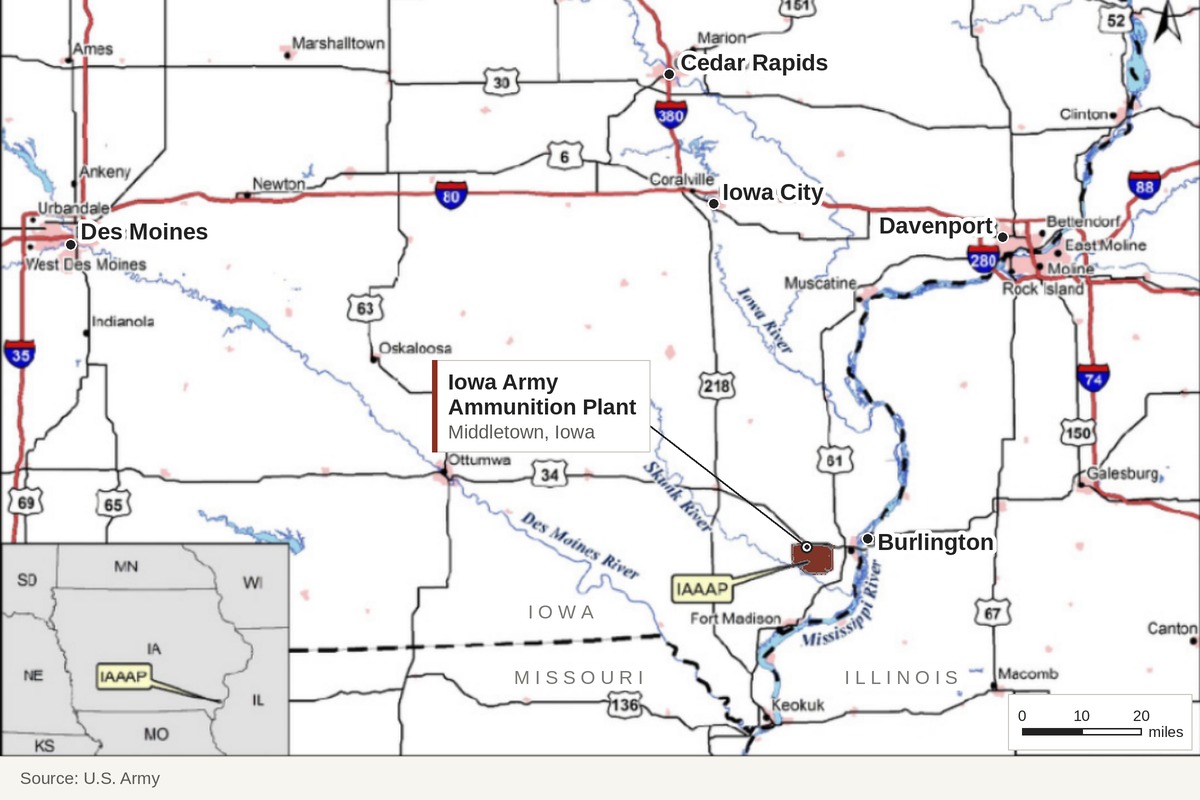
The U.S. Army detonated nearly 5 tons of unstable explosives Wednesday morning in southeastern Iowa, raising concerns about whether lead-containing dust could make nearby outdoor areas unsafe.
The Army destroyed a stockpile of lead azide at the Iowa Army Ammunition Plant in Middletown, citing the risk of an accidental explosion.
Initial air monitoring detected no airborne lead following the blast, and Iowa health officials say the risk of inhaling harmful amounts of lead appears low.
But environmental testing is continuing, and questions remain about whether lead settled on nearby soil, water or other surfaces. Residents and visitors in potentially affected areas should continue following official safety guidance.
Editor's Picks
With Thanksgiving weekend approaching and Iowa’s fall deer hunting season underway, those concerns extend to hunters, anglers, hikers and others planning to spend time outdoors in the region.
Here’s what officials are saying about the risks, which areas could be affected and what to know before heading outside.
Is it safe to go outside in southeastern Iowa?
Before Wednesday’s detonation, federal officials recommended that residents of Middletown and a designated area extending 5 miles southwest of the ammunition plant temporarily relocate. Those living 5 to 20 miles southwest were advised to shelter indoors. The Army outlined those precautions in its public safety advisory.
An emergency alert issued Wednesday morning instructed residents still within 20 miles of the plant to shelter in place because it was no longer considered safe to evacuate, The Associated Press reported.
In a Wednesday afternoon update, the Iowa Department of Health and Human Services said the risk of inhaling harmful amounts of lead appeared low based on air monitoring data reviewed so far. The agency is continuing to assess environmental findings, including soil samples, before determining whether additional public health recommendations are needed.
Before the detonation, Iowa health officials recommended the following precautions for people in potentially affected areas:
- Stay indoors with windows and doors closed for 24 to 48 hours after the detonation.
- Set heating and cooling systems to recirculate or turn them off to minimize outdoor air entering homes.
- Consider using a portable air cleaner with a HEPA filter.
- Monitor local news and official updates for changes to the affected area and safety guidance.
Residents should follow any newer instructions from local authorities. Iowa HHS also recommends washing hands before eating or drinking and removing shoes before entering homes to minimize tracking potentially contaminated material indoors.
According to Iowa health officials, lead can pose serious health risks when inhaled or swallowed, particularly for young children and pregnant women.
Which areas could be affected by lead dust?
The Army released a series of maps showing where airborne lead particles could travel and settle on the ground.
The maps released Wednesday morning show the projected path extending southwest from the ammunition plant. They’re based on atmospheric modeling and weather conditions, not confirmed measurements of lead contamination.
Iowa lead azide detonation: Maps and safety guidance
Status as of Nov. 25, 2026, 3:35 p.m. EST: The Army completed its controlled detonation the morning of Nov. 25. In a Nov. 25 release, EPA said its real-time air monitors reported zero detection of airborne lead one hour after the detonation. In a Nov. 25 update, Iowa HHS said the risk of breathing in harmful amounts of lead from the event appeared low based on air monitoring data reviewed to date. Environmental testing, including soil sampling, was continuing. At our last editorial review, the Army had not posted an official all-clear on its community notifications page; preliminary air results are not an all-clear. Latest Army notifications
If you have received evacuation or shelter-in-place instructions, follow them; updated local instructions take precedence. Conditions and official recommendations may change. This resource does not determine whether a specific location is safe. Follow the latest instructions from emergency management and public health officials.
Exposure maps
The U.S. Army publishes modeled maps of where lead from the detonation could travel through the air and where it could settle on surfaces. The maps below are pre-detonation projections, the last versions the Army posted before the detonation, reproduced unaltered. They are not confirmed contamination. At our review, the Army had posted no newer maps and no final post-detonation estimate of the affected area. Choose a map to view it.
Airborne dispersion map
Projected airborne lead dispersion

Select the map or “Enlarge map” to zoom in and read the original legend.
Pre-detonation modeled projection, not measured contamination. This map shows the output of a computer model. It does not show where lead has been confirmed, and weather conditions and updated modeling may change the projected area.
The Army’s computer model of where airborne lead from the detonation could travel. The shaded band shows the modeled plume path, and the markers T+0.5 through T+5 show its modeled position at points in time after the detonation. The map is titled “Mitigated 0.26 Dispersion”; its caption says the model reflects deliberate steps taken to reduce, contain and control the spread of hazardous dust.
Map legend in text (easier to read on small screens)
- Airborne Concentration: 0.18 µg/m³ – Lead Air Sampling Method Detection Limit
- Iowa Army Ammunition Plant
Panel text on the map: “Potential exposure to toxic lead dust. Lead air dispersion. Consider avoiding the highlighted area or remain indoors with windows/doors closed. Children under six are especially vulnerable to lead exposure. Await US Army to announce all-clear determination.”
Legend wording is transcribed from the Army map. Colors are approximate; the map image is authoritative.
Ground deposition map
Projected ground deposition of lead particles

Select the map or “Enlarge map” to zoom in and read the original legend.
Pre-detonation modeled projection, not measured contamination. This map shows the output of a computer model. It does not show where lead has been confirmed, and weather conditions and updated modeling may change the projected area.
The Army’s computer model of where lead particles could settle on the ground and other surfaces. Two shaded levels are compared with EPA dust-lead limits, as labeled in the legend. The map is titled “Mitigated 0.26 Deposition”; its caption says the model reflects deliberate steps taken to reduce, contain and control the spread of hazardous dust.
Map legend in text (easier to read on small screens)
- Surface Deposition: 100 µg/ft² – EPA Maximum Allowed for Lead on Windows (area shown on map: 29 mi²)
- Surface Deposition: 5 µg/ft² – EPA Maximum Allowed for Lead on Floors (area shown on map: 186 mi²)
- Iowa Army Ammunition Plant
Panel text on the map: “Potential exposure to toxic lead dust. Lead surface deposition. Consider avoiding the highlighted area or remain indoors with windows/doors closed. Children under six are especially vulnerable to lead exposure. Await US Army to announce all-clear determination.”
Legend wording is transcribed from the Army map. Colors are approximate; the map image is authoritative.
About these maps. Both maps are pre-detonation computer-model projections. They are not confirmed measurements of contamination. The Army revised the maps repeatedly in the hours before the detonation. Its Nov. 24 advisory says it will issue a final estimate of the affected area after the detonation; at our review, that estimate had not been posted.
A location outside a shaded area should not be assumed to be unaffected, and a location inside one has not been confirmed as contaminated. Check the Army’s notification page for the final estimate and any newer maps.
Army notification page: army.mil/asc (Iowa Army Ammunition Plant). The Army says earlier map versions are posted on its DVIDS page. The pre-detonation map set issued Nov. 24 is available as a PDF and has been superseded by later maps.
Environmental monitoring
EPA air sampling and monitoring dashboard
The U.S. Environmental Protection Agency launched a public dashboard on Nov. 25, titled Iowa Army Ammunition Plant Response Data Viewer – Air Sampling and Monitoring. No login is required. Before the detonation, EPA said its air monitoring would report data every 5 minutes during the event. The dashboard is built for full-screen viewing and works best opened directly.
If the dashboard does not display on this page, use the button above to open it in a new tab.
How to read monitoring data. A reading shown on a monitoring dashboard is not by itself a laboratory-confirmed result, a public health determination or an all-clear. This page does not interpret individual readings.
Initial post-detonation air results (Nov. 25). In a Nov. 25 release, EPA said that one hour after the detonation, all of its real-time air monitors were reporting zero detection of airborne lead, and that its monitors collected data throughout the event. EPA described these as initial results and said monitoring and sampling of air, land and water would continue in the following hours and days. These results concern airborne lead only. They are not an official all-clear and do not show whether soil, water, dust or outdoor surfaces are free of lead; results of that testing had not been released at our review.
According to the Army’s Nov. 24 advisory, results of post-detonation sampling by government personnel will be published when available, and residents should follow precautions until then. Decisions about an all-clear come from the Army and public health officials.
Types of monitoring
Air monitoring
Measures lead in the air around the plant and surrounding communities. EPA says it is collecting its own air samples, and the Army says air sensors will monitor the area. The EPA dashboard covers air sampling and monitoring.
Soil and surface sampling
Looks for lead that has settled on the ground and on surfaces. The Army said mobile teams would sample soil, surface water and surfaces after the detonation. In a Nov. 25 update, Iowa HHS said it would review soil sampling results as they become available. To request sampling, call EPA at 1-833-649-9624 and say you have a sampling request.
Water sampling
EPA says it is collecting water samples. Missouri’s Department of Natural Resources says it is monitoring the 10 public drinking-water systems in Missouri that draw surface water within 100 miles of the site.
Testing and cleanup assessments
Under EPA’s emergency permit, the Army must sample and monitor before and after the detonation, clean up contaminated areas and report to EPA. EPA says it will work with the CDC on decisions about lead remediation.
Before the detonation, EPA reported collecting 1,216 samples to test for lead: 650 soil, 297 dust, 210 water and 59 air. EPA said pre-detonation air sampling detected no lead and that it had deployed 300 personnel and contractors to Middletown and surrounding areas. The Army says residential properties testing above 200 mg/kg will be remediated at government expense.
Sources: EPA initial air monitoring release, Nov. 25 · EPA pre-detonation sampling release, Nov. 25 · Iowa HHS · EPA incident page · EPA news release, Nov. 24 · EPA emergency permit notice · Army announcement, Nov. 24 · Missouri DNR
Safety guidance
Summaries of official guidance, with the issuing agency and date. Select a topic to expand it. Always check the linked source for the latest version.
Residents and visitors
Status at our review (Nov. 25, 3:35 p.m. EST): The detonation was completed the morning of Nov. 25. In an update timestamped 12:30 p.m. Nov. 25, Iowa HHS said that, based on information shared by the Army and air monitoring data reviewed to date, it believes the risk of breathing in harmful amounts of lead from the event is low. It said it will continue to review environmental monitoring, including soil sampling results, to determine whether any additional public health recommendations are needed. The Army had not posted an official all-clear. Instructions below that were issued before the detonation are labeled as such; updated local instructions take precedence.
- Everyday precautions (Iowa HHS, Nov. 25 update): Wash your hands before eating and drinking, and take your shoes off at the entrance of homes to minimize tracking. If you are concerned about possible lead exposure, contact your health care provider about whether blood lead testing is appropriate.
- Evacuation (recommended before the detonation): FEMA recommended relocation for residents of Middletown and nearby areas within a 5-mile cone extending southwest of the plant, plus a 1-mile buffer, and funded short-term lodging through Nov. 27, with possible extensions. The Army said evacuees would be notified by phone when the all-clear is issued. FEMA helpline: 1-800-621-3362.
- Shelter in place (Army advisory issued Nov. 24, before the detonation): Residents who did not evacuate were advised to stay indoors with windows and doors closed during the potential exposure period, keep heating or cooling on recirculation until the plume passed, keep small children and pets indoors and turn off fans that pull in outside air.
- Southwest of the plant (before the detonation): Iowa’s governor’s office, relaying FEMA, said residents 5 to 20 miles southwest of the plant should stay indoors with windows closed.
- How long (pre-detonation guidance): Iowa HHS advised people in a potentially affected area to stay indoors with doors and windows closed for 24 to 48 hours after the detonation; its Nov. 25 update does not repeat that advice. Illinois EPA advised keeping windows and doors closed for 24 hours after the detonation. Follow any updated local instructions.
- Outdoor activity (Army advisory, Nov. 24): The Army advised everyone, especially infants, children, pregnant women and people with chronic conditions, to avoid outdoor activity in affected areas until further guidance is issued. No further Army guidance had been posted at our review.
- Travel (pre-detonation guidance): The Army advised avoiding unnecessary travel through affected areas and evacuation zones. Iowa HHS and Illinois EPA advised setting vehicle air to recirculate when driving through dusty or affected areas.
- Most sensitive groups: Children under 6, pregnant women and people with chronic conditions such as heart disease, dementia or chronic kidney disease (Army advisory).
Missouri: In a Nov. 25 statement, Gov. Mike Kehoe said EPA reported no detectable traces of lead heading toward Missouri and that there was no anticipated impact to air, water, agriculture and public health. State officials said they would continue to evaluate post-detonation findings.
Illinois: In a Nov. 25 release, Illinois EPA said light winds resulted in little to no impact to Illinois and that data available in the immediate hours after the detonation showed no airborne lead detected. State agencies said they would remain on standby until the federal government releases final data for the event.
Sources: Army public safety advisory, Nov. 24 · Iowa HHS · Iowa governor, Nov. 24 · Missouri governor, Nov. 25 · Illinois EPA release, Nov. 25 · Missouri DNR · Illinois EPA updates
Hikers and campers
- The Army’s Nov. 24 advisory said to avoid outdoor activity in affected areas until further guidance is issued; no further Army guidance or all-clear had been posted at our review. Check the Army’s notification page for the latest status before you go.
- In a Nov. 25 update, Iowa HHS said the risk of breathing in harmful amounts of lead from the event appeared low based on air monitoring reviewed to date, and that it was still reviewing environmental results, including soil samples. Airborne results do not show whether lead settled on soil or surfaces.
- Check current public health advisories from the state you plan to visit (Iowa, Missouri or Illinois) and any access restrictions or closures posted by the agency that manages your destination, such as a state park, county conservation board or federal land manager.
- At our review, we did not find incident-specific closures posted by the Iowa Department of Natural Resources, Missouri DNR or Illinois EPA. That does not mean any area has been determined safe. Contact the land manager directly if you are unsure; Iowa DNR says state offices are closed Nov. 25-27 for the holiday.
- Modeled maps are projections. Do not treat a trail or campground outside a shaded area as cleared, or one inside a shaded area as confirmed contaminated.
Sources: Army public safety advisory · Iowa HHS · Iowa DNR · Iowa HSEMD resource hub
Hunters and anglers
- Monitor state wildlife and public health agencies for guidance on hunting access, waterways and eating harvested fish and wild game.
- At our review, we did not find an incident-specific advisory about fish or wild game from Iowa, Missouri or Illinois agencies. The absence of an advisory is not a determination that fish or game from the area are safe to eat, and this page makes no such determination.
- Iowa DNR’s fish consumption page covers longstanding statewide advisories (such as PCBs and mercury). Those advisories are not specific to this incident; the page did not reference the detonation at our review.
- The Army’s Nov. 24 outdoor-activity guidance for affected areas applies to hunters and anglers as well. Nov. 25 air results concern airborne lead only; soil and water results had not been released at our review.
Sources: Iowa DNR fish consumption (general) · Iowa DNR · Missouri DNR incident page · Illinois EPA incident page
Farmland, livestock and waterways
Officials have raised concerns about lead dust settling on pasture, feed, water sources and equipment. These are precautions, not findings that contamination has occurred.
- Iowa livestock producers within 20 miles of Middletown (Iowa Department of Agriculture and Land Stewardship guidance issued Nov. 24, before the detonation; not updated at our review): keep livestock at an alternate location or indoors until the Army gives the all-clear and the plume has passed; dust may take several hours to settle. Afterward, power-wash fencing, feeders and portable water tanks once dust has settled, and work with a veterinarian on monitoring and testing.
- Soil and forage sampling: IDALS advises asking the Army for post-detonation soil and forage samples.
- Missouri: In a Nov. 25 statement, Gov. Kehoe said there was no anticipated impact to agriculture. Before the detonation, Missouri DNR said optional lab testing was available for soil, hay and feed, with animal testing submitted through a veterinarian.
- Illinois (pre-detonation guidance): Illinois EPA advised moving pets and livestock indoors or to an alternate location, covering or moving feed and water, and consulting a veterinarian about signs of lead poisoning.
- Waterways and drinking water: EPA collected 210 water samples before the detonation, and Missouri DNR is monitoring surface-water drinking systems. At our review, we did not find an incident-related drinking-water advisory from Iowa, Missouri or Illinois agencies.
- Claims: Livestock or property damage claims go to the Army’s Office of the Staff Judge Advocate, Fort Leavenworth, 913-684-3564.
Sources: IDALS livestock guidance · Missouri governor, Nov. 25 · Missouri DNR · Illinois EPA · EPA
After an official all-clear
An all-clear for airborne exposure is not the same as a finding that outdoor surfaces, soil or water are free of lead. Lead that settles as dust can remain on surfaces after the airborne exposure period ends. At our last editorial review (Nov. 25, 3:35 p.m. EST), the Army had not posted an official all-clear. Officials have issued these precautions:
- After officials say the exposure period has ended, clean indoor and outdoor surfaces children may touch (Army advisory, following Iowa HHS guidance).
- In the deposition area, wet-clean high-contact surfaces, including play equipment, toys, furniture, handrails, patios, decks and exterior windowsills (Army advisory).
- Wipe down outdoor surfaces children touch, such as play sets, railings and windowsills, with a wet cloth (EPA, Nov. 25).
- Wash your hands before eating and drinking, and take your shoes off at the entrance of homes to minimize tracking (Iowa HHS, Nov. 25 update).
- Wash outdoor surfaces with soap and water where dust is visible (Iowa HHS, pre-detonation guidance).
- Wet-clean rather than dry-sweep; consider washing your vehicle and replacing its cabin air filter if needed (Illinois EPA, Iowa HHS).
- Results of post-detonation sampling will be published when available; follow precautions until then (Army advisory).
Health questions: Iowa HHS says no safe level of lead has been identified, particularly for young children and pregnant women, and that lead exposure may not cause immediate symptoms. A blood lead test is how exposure is identified; talk with your health care provider about whether testing is appropriate. Iowa HHS: 800-972-2017.
Sources: Army public safety advisory · Iowa HHS · Illinois EPA · EPA news release, Nov. 25 · EPA: Actions to reduce lead exposure
Official updates
Official agency pages may contain more recent information than this resource. Check them directly for the current status.
Compiled by Camp & Country from official U.S. Army, EPA, FEMA, Iowa, Missouri and Illinois sources. Maps are reproduced from the U.S. Army without alteration. This resource is updated by editors and does not receive live data or update automatically. Information last reviewed: Nov. 25, 2026, 3:35 p.m. EST.
Federal government
- U.S. Army: Iowa Army Ammunition Plant community notificationsPrimary source for detonation status, new maps, advisories and any all-clear.
- U.S. Army: Detonation-day message, Nov. 25Army notice issued shortly before the detonation.
- U.S. Army: Deposition and dispersion maps, 8 a.m. CST Nov. 25The last map update before the detonation; shown on this page.
- U.S. Army: Public safety advisory, Nov. 24Evacuation, shelter-in-place and post-detonation cleaning guidance.
- U.S. Army: Detonation announcement and background, Nov. 24Why the Army chose an in-place detonation, safeguards and claims.
- EPA: Air sampling and monitoring dashboardPublic air monitoring data viewer launched Nov. 25; the Army also linked it at 12 p.m. Nov. 25.
- EPA: Initial post-detonation air monitoring, Nov. 25Zero detection of airborne lead on real-time monitors one hour after the detonation; sampling continues.
- EPA: IAAAP Lead Azide incident pageEPA updates, sampling requests, permit documents.
- EPA: Pre-detonation sampling update, Nov. 251,216 pre-detonation samples; plans for post-detonation sampling.
- EPA: Interagency public update, Nov. 24Scope of EPA air, soil and water sampling.
- EPA: Emergency permit public noticeRCRA emergency permit terms and monitoring requirements.
- FEMA: DisasterAssistance.govRegister for relocation assistance; helpline 1-800-621-3362.
- CDC: Childhood lead poisoning preventionGeneral information on lead exposure and testing in children.
Iowa
- Iowa Homeland Security and Emergency Management: Resource hubState coordination page linking federal and state resources.
- Office of the Governor: Disaster proclamation, Nov. 24Proclamation for Des Moines, Lee and Van Buren counties.
- Iowa HHS: Lead exposure and public health guidanceUpdated Nov. 25 after the detonation: health risk assessment, hygiene precautions and blood lead testing.
- Iowa Department of Agriculture and Land Stewardship: Livestock guidanceGuidance for producers within 20 miles of Middletown.
- Iowa Department of Natural ResourcesParks, hunting and environmental news. No incident-specific page found at our review.
- Iowa DNR: Fish consumption and safetyGeneral statewide advisories; not specific to this incident.
Missouri
- Missouri Gov. Mike Kehoe: Statement following the detonation, Nov. 25Reports no detectable lead heading toward Missouri and no anticipated impacts.
- Missouri Department of Natural Resources: Iowa lead azide detonationMissouri’s official update page: public health guidance, drinking-water monitoring and agricultural testing. Had not added post-detonation results at our review.
Illinois
- Illinois EPA: Illinois remains on standby, Nov. 25Little to no expected impact; no airborne lead detected in data available after the detonation.
- Illinois EPA: Iowa Army Ammunition Plant updatesIllinois’ official update page. Last updated 12:45 p.m. CT Nov. 25, at our review.
Key phone numbers
- FEMA helpline (evacuation, assistance), 24/7: 1-800-621-3362
- EPA sampling requests: 1-833-649-9624 · other EPA questions: R7-IAAAP@epa.gov
- Iowa HHS: 800-972-2017
- Iowa Army Ammunition Plant public affairs: 563-505-4359
- Army claims (Fort Leavenworth): 913-684-3564
Use the zoom buttons, then scroll to pan. Press Esc to close.
Officials in neighboring states are also monitoring the situation for potential environmental impacts beyond Iowa’s borders.
In a statement Wednesday, Missouri Gov. Mike Kehoe said federal monitoring had found no detectable lead heading toward the state. Officials said they did not anticipate impacts to air, water, agriculture or public health but would continue reviewing environmental findings. The Missouri Department of Natural Resources is providing updates for residents.
The Illinois Environmental Protection Agency said Wednesday that weather conditions suggested little or no impact to the state and that data available in the hours following the detonation showed no airborne lead detected. State agencies remained on standby pending additional federal findings.
The U.S. Environmental Protection Agency (EPA) reported that its real-time monitors detected no airborne lead one hour after the detonation. The agency has also made a public air monitoring and sampling dashboard available. Those initial results do not establish whether lead settled on surrounding surfaces.
Could the detonation affect farmland, waterways and wildlife?
The extent of any environmental contamination remains unknown.
The EPA said Wednesday it had collected more than 1,200 air, soil, dust and water samples in communities surrounding the ammunition plant before the detonation. Those samples provide a baseline for comparison with testing conducted during and after the blast to help determine whether cleanup measures are necessary.
The EPA’s emergency permit requires the Army to monitor for environmental contamination and take corrective action where necessary.
The Iowa Department of Agriculture and Land Stewardship issued updated guidance for livestock producers within 20 miles of Middletown. It advises farmers to request soil and forage testing through the Army or arrange their own sampling if necessary. Producers should also work with veterinarians to monitor livestock for signs of lead poisoning and determine whether testing the animals is needed.
What should hunters and anglers know?
The detonation comes during Iowa’s fall archery deer season, which runs through Dec. 4. The state’s two regular gun deer seasons begin Dec. 5 and Dec. 12 and are expected to draw more than 100,000 hunters, according to the Iowa Department of Natural Resources (DNR).
The DNR has granted the Army access to state-managed lands in potentially affected areas for environmental testing. In a statement Sunday, the governor’s office said the department would independently review the findings to determine whether further action is needed.
The preliminary air-monitoring results don’t establish whether fish or wild game harvested in potentially affected areas are safe to eat. The absence of a specific consumption advisory should not be taken as confirmation that they have been cleared.
Anyone planning to hunt, fish or explore public lands in the region should follow current public health guidance and check for updates from the Iowa DNR as environmental testing continues. Anglers can also monitor the state’s fish consumption advisories for any changes.
When will it be safe to return outdoors?
The potential for lead exposure doesn’t necessarily end once airborne particles have settled. Lead-containing dust may remain on the ground and other outdoor surfaces.
Once officials determine the airborne exposure period has ended, the Army advises residents to clean surfaces children may touch. In designated deposition areas, that includes wet-cleaning playground equipment, handrails, patios, decks and other frequently touched surfaces.
The Army says it will release a final estimate of the affected area and publish environmental sampling results as they become available.
Until more is known, residents and visitors should check the Army’s latest community notifications and Iowa’s public health guidance before heading outdoors in potentially affected areas. Follow any evacuation, shelter-in-place or other safety instructions issued for your location.
Last updated Nov. 25, 2026. Environmental monitoring remains underway. Readers should consult the official agency links above for newer safety information.
Your home base for the great outdoors. Sign up for the Camp & Country newsletter.
Keep the adventure going. Follow Camp & Country on Instagram, Facebook, X and Bluesky for outdoor inspiration, trip ideas and more.