


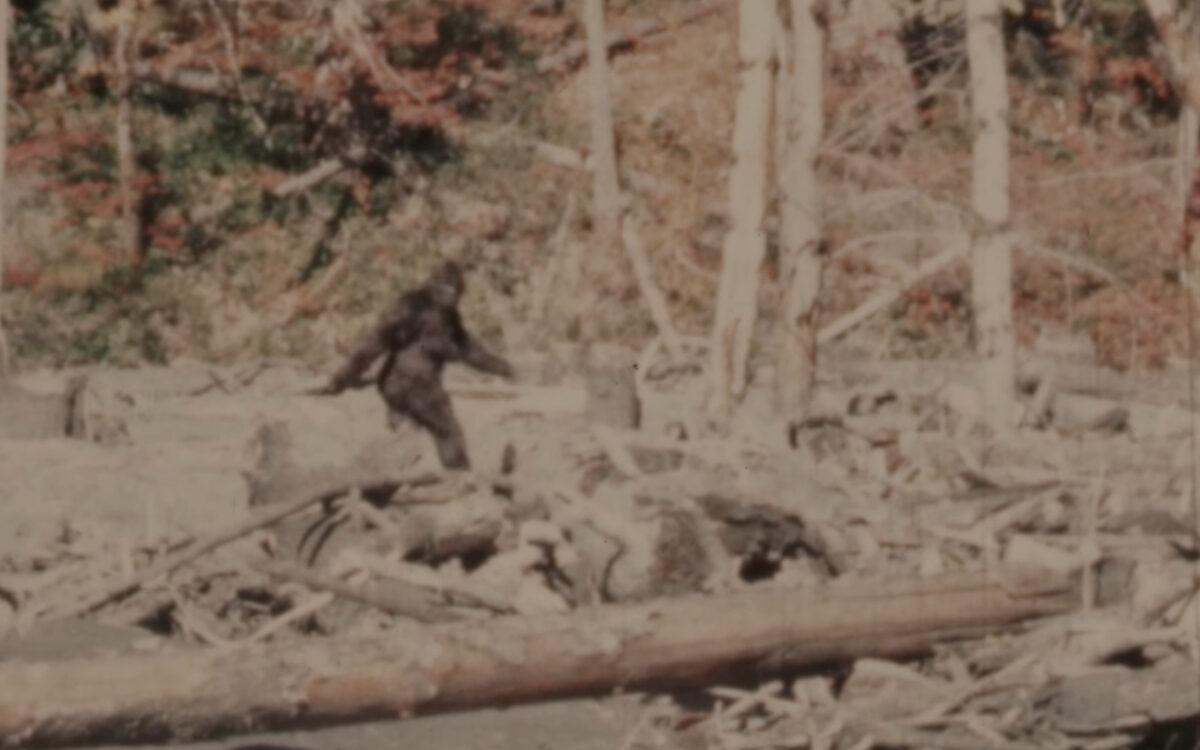
Bigfoot has spent decades eluding cameras, scientists and believers across America. But like so many other warm-blooded, two-legged creatures, he apparently couldn’t escape government paperwork.
On Oct. 15, the U.S. Forest Service added three decades-old documents to its public online archive under the heading “Bigfoot/Sasquatch Records.”
The files include a 1982 investigation into giant footprints in the Pacific Northwest, a Montana newspaper article about mysterious tracks in the snow and a decades-old report of a strange incident during a hunting trip.
So, has the federal government finally cracked one of our most enduring wilderness mysteries? Not exactly.
Editor's Picks
The curious case of the 15-inch footprints
One document details a Forest Service investigation into mysterious footprints in the Washington section of Umatilla National Forest, which spans northeastern Oregon and southeastern Washington.
On June 17, 1982, Forest Service wildlife biologist Rodney Johnson joined a group investigating reported Bigfoot tracks in the Mill Creek watershed.
At one site, investigators found six footprints spanning about 25 feet along a muddy trail. At another, they documented roughly 18 prints near an elk wallow, a muddy area where elk roll around.
The team photographed the tracks and made plaster casts. One footprint measured about 15 inches long and 7 inches wide.
Johnson concluded that the tracks were not made by a creature weighing more than 300 pounds and walking on two legs. The impressions were shallower than the investigators’ boot prints, and the stride length remained unusually consistent across different slopes.
Still, he acknowledged that if the tracks were fake, someone had gone to considerable trouble to make them look convincing.
U.S. Border Patrol tracker Joel Hardin was more definitive. In a separate memo, he concluded that the tracks were a hoax, possibly created using a device made from plaster or rubber.
Big feet, strange sounds and a Montana mystery
On Jan. 3, 2003, an 8-year-old boy spotted unusually large footprints near a sawmill outside Plains, Montana. Neighbors later reported finding hundreds of tracks, which they followed into the surrounding woods.
The discovery was described in a Clark Fork Valley Press article included in the newly released Forest Service records. The tracks faded where the snow thinned beneath the trees. Photographs showed footprints measuring up to 16 1/2 inches long.
Another historical account describes a hunting party that discovered enormous tracks while retrieving an elk in Montana’s Petty Creek area in the 1940s. The writer also recounted a hunter’s similar experience the following year, involving strange tracks, a strong odor and grunting noises.
Neither document establishes what made the tracks or caused the reported sounds.
The truth is still out there (apparently)
The Forest Service’s records offer no proof that Bigfoot exists. But for those who have spent years searching for the elusive creature, the fact that the government kept these files at all is noteworthy.
As The New York Times reported, some enthusiasts welcomed the records as a sign that reports of Bigfoot were receiving official attention rather than being dismissed outright.
The Forest Service also held a public presentation about Bigfoot near Yosemite in October, according to The Washington Post. An agency spokesperson said public and research interest are among the factors considered when deciding which records to release.
For Bigfoot hunters, the search continues. Now, if only Bigfoot would cooperate.
The Bigfoot Reading Room
Bigfoot left tracks. The Forest Service left paperwork.
Forest Service investigationThe 15-inch footprintsSummary and PDFClose file
Forest Service wildlife biologist Rodney L. Johnson examined reported tracks in the Mill Creek watershed of Umatilla National Forest in June 1982. The group photographed the prints and made plaster casts. Johnson concluded the tracks were made by something other than a 300-pound-plus, two-footed creature. A month later, U.S. Border Patrol tracker Joel Hardin called them a hoax.
Look for thisThe caption under Photograph #2 on page 2 describes a right footprint about 15 inches long and 7 inches wide. On page 7, Hardin calls the tracks “a very clever attempt to perpetrate a hoax.”
Open original PDF: 1982 Forest Service investigation, 7 pages
Newspaper clippingThe trail that disappearedSummary and PDFClose file
The Clark Fork Valley Press reported that an 8-year-old boy found large footprints in fresh snow near a neighbor’s sawmill outside Plains, Montana. Neighbors followed them about 100 yards into the woods. Under the trees, where there was little snow and the ground was hard, the prints faded out.
Look for thisA photo caption at the top right of the front page reports a print 16½ inches long and 8½ inches wide. The measurements and sightings are neighbors’ accounts as reported by the newspaper. No agency examined these tracks.
Personal recollectionTracks near the elkSummary and PDFClose file
In a local history of Montana’s Petty Creek area, Leo T. Kinney recalled going in with three other men to pack out a bull elk. When they arrived, he wrote, only the entrails were left, and a large set of tracks led away through the snow. The following year, he recounted, another hunter came across similar tracks, smelled a strong odor and heard grunting. Kinney noted that no one actually saw an animal.
Look for thisThe elk passage is about halfway down page 3, followed by W.W. Schmitz’s account. Kinney wrote this around 1980, recalling events from decades earlier.
Records: U.S. Forest Service. Browse the Forest Service’s FOIA Reading Room
Your home base for the great outdoors. Sign up for the Camp & Country newsletter.
Keep the adventure going. Follow Camp & Country on Instagram, Facebook, X and Bluesky for outdoor inspiration, trip ideas and more.