
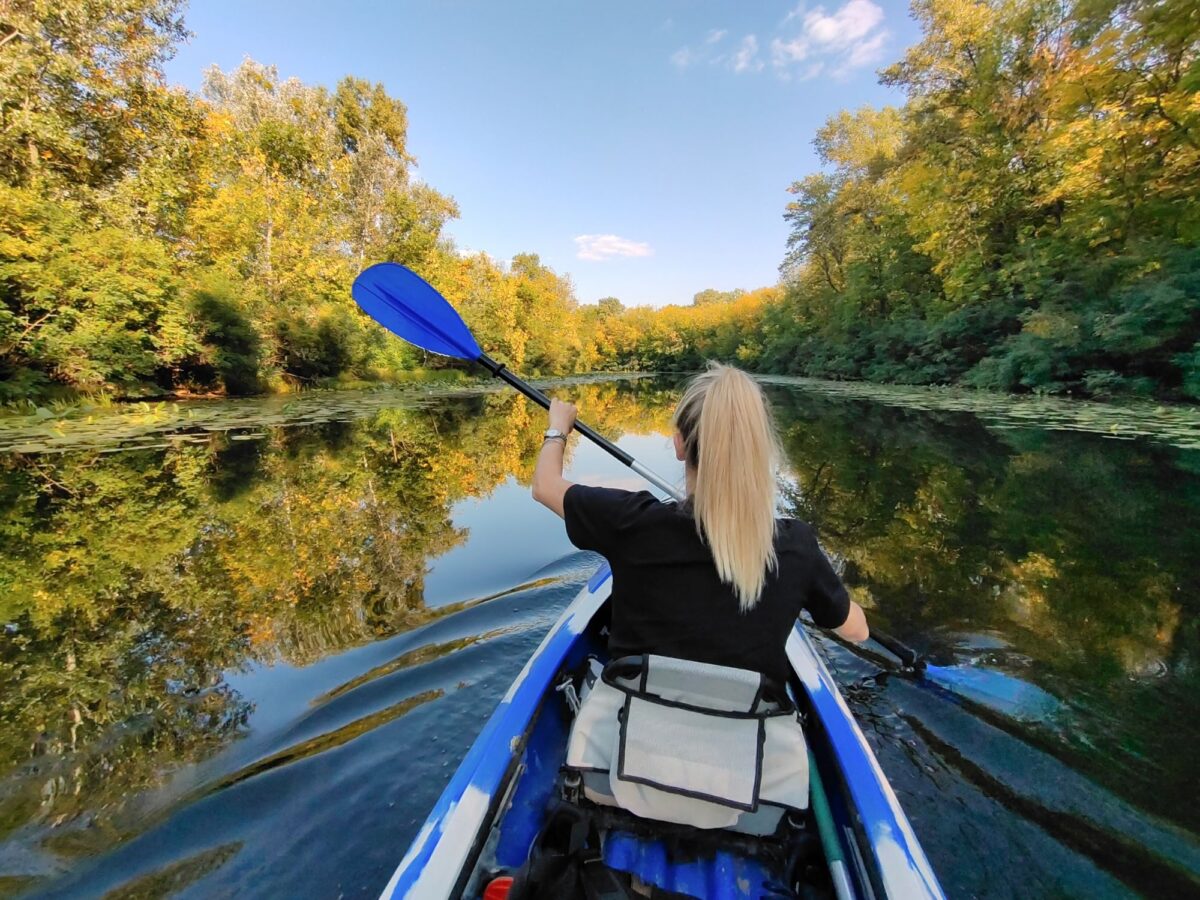
The photo is hard to resist: glassy water, a paddler silhouetted against a sunrise and not a ripple in sight. It’s the kind of image that sends people straight to a sporting goods store.
But a scenic view doesn’t tell you whether a spot suits a beginner. Wind picks up. Motorboats crowd the cove. A seemingly easy route can become a slog back to shore.
A successful first outing starts before you launch, from choosing the right waterway to checking conditions and packing the essentials. This guide breaks down each step to help you avoid common beginner mistakes — and make paddling a hobby you’ll want to return to.
1. Pick a destination with calm, protected water
Before you run out and buy a watercraft, pick the place you want to go. Where you paddle shapes almost every other decision about your first trip on the water, like the equipment you’ll need, how you’ll dress and when you’ll go.
Then research the waterway to learn where you can launch and where you can get out. Check for hazards such as dams and fallen trees. For your first outing, avoid routes with locks, low-head dams or strong currents. Consider how you’ll get back to your starting point if your route requires a separate takeout.
Kelsey Bracewell, director of education, insurance and membership at the American Canoe Association, says the best choice for beginners is “calm water that is protected from big wind, big waves, outside boat traffic, and is within swimming distance to shore.”
Use up and down arrow keys to resize the meta box pane.
That can be a bay, pond or sheltered stretch of water that gives you room to practice without having to navigate strong currents or compete for space with motorboats, personal watercraft and other water users. Staying close to shore doesn’t replace wearing a life jacket or knowing how to recover after a capsize.
If you’re unsure where to start, consider booking a guided outing. A local outfitter or an ACA-certified instructor can help you choose a route suited to your abilities and get comfortable with the basics. Bracewell, who has instructed for 17 years, says a good first experience is what brings people back.
2. Choose a craft that suits your plans
Bracewell advises asking what you want to do on the water, not which type of paddling is easiest. “All of these activities in life in general are challenging if you’ve never done them before,” she says, and the right choice “depends upon what that person’s goal is. Do they want to take their kids and their dog, or are they just trying to go get some exercise for themselves or are they going to go bird watching or fishing?”
Kayaks are widely available in sit-inside and sit-on-top designs, with both rigid and inflatable options across a range of budgets. They can work well for solo paddlers or groups heading out together.
If you’re wary of feeling confined, consider a stand-up paddleboard. You can sit, kneel, lie down or stand without sitting inside a cockpit.
Canoes offer room for paddling with others or carrying supplies for a picnic or an overnight camping trip.
3. Pack for your boat and your car
A good packing list helps you stay safe, comfortable and prepared if something goes wrong. Start with a craft suited to you, your gear and the waterway, plus an appropriate paddle. Wear a properly fitted, U.S. Coast Guard-approved life jacket throughout the outing.
Bracewell, who has paddled for 20 years, brings food, water and extra clothes on every trip, packed in a dry bag. She learned why in her college paddling club, where she says she often ended days “cold and starving.” Her other go-to essentials include:
- Small first-aid kit
- Flashlight
- Cutting tool, such as a pocketknife or trauma shears, for cutting tangled rope or fishing line
- Fully charged phone, plus downloaded maps or screenshots of your route
- Whistle on your life jacket
- Written list of emergency phone numbers
Keep your whistle attached to your life jacket and your phone protected in a waterproof pouch secured to you, so they remain accessible if you become separated from your craft.
Back at the car, leave a towel, extra food and water, dry clothes, a blanket, a power bank and a bin for wet gear.
4. Check weather and water conditions before heading out
Before launching, check the forecast for rain, thunderstorms, wind and changing conditions. Thunderstorms and lightning are reasons to postpone a trip, while strong winds can push your boat off course and create waves that splash into an open canoe or kayak.
Wind direction matters, too. Consider the wind on both the outward and return legs. If conditions could make either leg difficult, choose a more sheltered route or postpone the outing. “Going against the current and against the wind will tire out even the most in-shape, athletic people,” Bracewell says. “You can’t fight Mother Nature for long.”
Check the National Weather Service forecast and any relevant marine advisories for your destination. Bracewell also recommends checking radar rather than relying only on current conditions.
For coastal outings, NOAA’s Tides and Currents provides tide predictions, water levels and current information; marine forecasts provide wind and wave guidance. Depending on where you’re paddling, check local river levels, flow rates or lake conditions, too.
5. Dress for the water
When paddling, dress for the water temperature, not just the air. Even if you never capsize, splashes and spray can leave you wet and cold.
Skip cotton, which absorbs water and dries slowly. “Going out there wearing cotton T-shirt and jeans, you’re going to get wet and you’re going to stay cold,” Bracewell says.
Instead, choose quick-drying synthetic clothing or insulating layers such as fleece or wool, as conditions require. Ordinary clothing does not replace protection for cold-water immersion. Ask an instructor or outfitter whether you need a wetsuit or dry suit for the water temperature and conditions. If you don’t have appropriate equipment and training, choose warmer water for your first outing.
Warm weather calls for its own precautions. Wear sun-protective clothing, a hat, sunglasses and sunscreen, and bring enough water to stay hydrated. Plan your outing for a cooler part of the day when temperatures are high, and pack snacks to keep your energy up. Water shoes or other secure footwear can help protect your feet from rocks, shells and slippery surfaces around launch areas.
6. Tell someone about your trip, and don’t go alone
Before you launch, share a float plan with someone staying on shore. Include who’s going, your launch and takeout locations, intended route, a description of your craft and when you expect to return.
Agree on a check-in time and when that person should contact emergency services if you’re overdue. Their role is to pass along your trip information, not attempt a rescue themselves.
Bracewell also recommends paddling in a group of three, so if someone gets injured or becomes too tired to continue, one person can stay with them while the other seeks help.
7. Understand the basics of how to launch
Getting in and out can be awkward for beginners. The technique depends on your craft and launch site, so have an instructor or outfitter demonstrate before you set off.
First and foremost, balance your load. Distribute gear evenly from front to back and side to side, and stay within the manufacturer’s capacity limits for people and equipment. Secure gear so it won’t shift or fall overboard.
Keep your weight low as you get in. Bracewell recommends maintaining “three points of contact,” such as two hands and a foot, as you move into position. In a canoe, have your partner steady the boat while you board, then help steady it for them.
For a stand-up paddleboard, move into water deep enough to keep the fin clear of the bottom before climbing aboard. Start kneeling or seated, and move clear of the launch area before attempting to stand. Ask your instructor or outfitter about the appropriate leash for the waterway. An ankle leash can create an entrapment hazard in moving water.
Before pushing off, scan the water for approaching boats and other users.
8. Know what to do if you fall in
Capsizing can happen to even experienced paddlers, so learn and practice how to recover with an instructor before heading out. If you fall in, keep your life jacket on, get your breathing under control and assess the immediate hazards.
Your next move depends on your craft and the conditions. Getting back onto a paddleboard or sit-on-top kayak is different from recovering a swamped canoe or sit-inside kayak. Don’t assume you’ll be able to climb back aboard without help.
If it’s safe to do so, stay with your craft. It is often easier for rescuers to spot than a person in the water. Use your whistle to signal for help, and call for assistance if you can’t get back aboard or reach safety.
9. Give yourself time to learn
Expect a learning curve during your first outing. It may take the first 10 to 15 minutes to get a feel for how your boat responds to your paddle. Your boat might zigzag instead of traveling in a straight line, and that’s normal. Try paddling forward, backward and sideways, or in circles, to get a feel for how your strokes affect your direction.
One surprise for beginners is how much the wind and current can move a boat when they stop paddling. Pay attention to your position relative to shore and other landmarks, and correct your course before you drift toward hazards or farther from your intended route.
Above all, give yourself room to learn. “Giving yourself just permission to not be good at it for a few minutes is perfectly fine,” Bracewell says. “You don’t have to be proficient or receive technical skill instruction to have fun.”
Your home base for the great outdoors. Sign up for the Camp & Country newsletter
Keep the adventure going. Follow Camp & Country on Instagram, Facebook, X and Bluesky for outdoor inspiration, trip ideas and more.